Electricity

Atoms & Electrons
Atoms are the smallest building block of matter, which is anything we can see, touch, or feel. Atoms are composed of three different types of subatomic particles: the proton, the neutron, and the electron.
At the very center of the atom is the nucleus, which is a dense collection of protons and neutrons, the heavy stuff that give atoms the vast majority of their mass. Surrounding the nucleus are extremely light subatomic particles called electrons.
Positive & Negative Charge
Protons and electrons have a characteristic called charge, which can be either positive (+) or negative (-). Electrons are attracted to protons due to their opposite electrical charges. This electrostatic attraction is the fundamental force that keeps electrons bound around the nucleus, and keeps electrons from flying away from the nucleus. Opposite charges attract, like charges repel.
- Protons (+) are subatomic particles with positive charge.
- Neutrons are subatomic particles with no charge.
- Electrons (-) are subatomic particles with negative charge.
Orbitals & Shells
An electron orbital is three-dimensional mathematical function that describes the region of space around an atom's nucleus where an electron is most likely to be found. Each orbital can hold a maximum of two electrons.
These orbitals are grouped into shells, which represent the different energy levels of the atom. Higher-energy shells generally correspond to a greater average distance from the nucleus. Atoms can have up to seven shells, which correspond to the the seven periods of the periodic table (the number of rows down), and are labeled from 1-7, or K-Q.
The outermost shell is called the valence shell. The electrons in this shell largely determine an atom's chemical properties. Valence electrons are lonely and are less tightly bound than inner electrons, and can be more easily be removed or shared during chemical reactions. Valence electrons determine conductivity, which is the atom's ability to transmit electricity.
Protons and electrons are happiest and most stable when they exist in equal numbers - the number of electrons is usually the same number of protons in an atom. In certain circumstances, electrons in the valence shell can be dislodged from their atom. This imbalance of protons and electrons will attempt to correct itself - as electrons leave, other electrons will jump in to fill the gaps. This is how electricity happens.
Electricity is the movement or passage of electrons, from one atom to the next.
Conductive Materials
Some materials are significantly better than others at carrying electricity.
Electrons surround the nucleus in various levels called shells. An atom that has just one electron in its outer shell can readily give up that electron, which is necessary to carry electricity. These substances are conducive to carrying electricity and are called conductors. The opposite of conductance is called resistance. Some substances are more resistant to the passage of electricity than others, and these are known as resistors. A substance with a very high resistance is called an insulator.
Atoms can have up to seven shells. These shells represent different energy levels of the atom. The number of rows down on the periodic table determines the number of shells the atom has. The shell number is labeled from 1-7, or K-Q. The outermost shell is called the valence shell. This shell is special because it determines the chemical properties of an atom. Some atoms have just one electron in their valence shell, while others have a lot. Some of these electrons are loosely bound to the atom, while others are tightly bound. Being in the outermost shell means that some loosely bound electrons can be pushed out of their valence shell.
- Conductors are a material with a sea of free moving, loose electrons. Conductors have 1-3 valence electrons. If a conductor is shot with a free electron, it will take the place and propel the other electron away. Common conductors include copper, silver, gold, and steel.
- Semiconductors are a material with some free moving, loose electrons. Semiconductors have 4 valence electrons. Common semiconductors include silicon.
- Insulators are a material with very few free moving, loose electrons. Insulators have 5+ valence electrons. If an insulator is shot with a free electron, it will just bounce off. Common insulators include rubber, glass, plastic, wood, and dry air.
Electric current flows through conductors easily, flows through semiconductors only some of the time, and does not flow through insulators well at all.
Conductors let their electrons move on freely, while insulators like to keep onto their electrons.
P-Type & N-Type Semiconductors
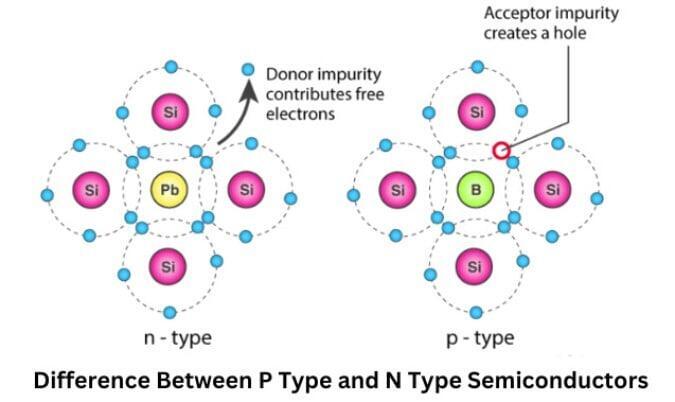
P-Type Semiconductors
Silicon is doped with elements such as Boron or Gallium, which have 3 valence electrons. This creates a deficiency of one electron in the bonding structure, known as a hole. Electrons from nearby atoms can move to fill these holes, causing the holes to behave like mobile positive charge carriers.
N-Type Semiconductors
Silicon is doped with elements such as Phosphorus or Arsenic, which have 5 valence electrons. Four electrons form covalent bonds with neighboring silicon atoms, while the fifth becomes a free charge carrier. These free electrons increase conductivity.
The P-N Junction
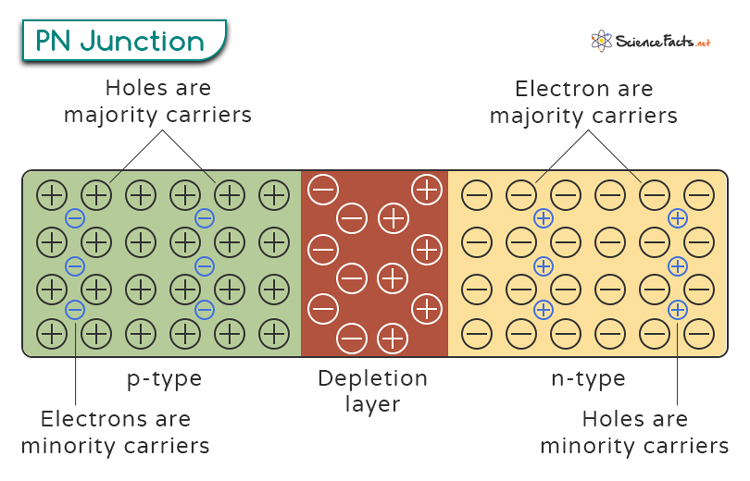
The P-N junction forms when P-type and N-type semiconductor materials are joined together. Electrons from the N-type region and holes from the P-type region diffuse across a boundary known as the "depletion region" and recombine.
This region contains fixed ions which create an electric field. This electric field prevents electrons from freely moving across the region under zero bias, which allows the junction to control the direction of current flow.
Applying an external voltage can change this barrier, allowing it to control the direction and magnitude of current flow. Applying an external voltage shrinks the barrier, allowing the current to flow. With no external voltage, the barrier grows, stopping the current.
The depletion region is miniscule, approximately 0.1 to 10 micrometers across.
Direct Current (DC) and Alternating Current (AC)
Direct Current (DC) flows in one direction around a closed circuit. Electrons move continuously from the negative side of the source, through the circuit, and back to the positive side. Commonly used in batteries and electronics because they require a steady, constant voltage to power sensitive components like transistors and to store energy.
Alternating Current (AC) changes direction repeatedly (50-60 times per second), causing the electrons to move back and forth while still requiring a closed circuit. Commonly used in mains electricity due to its high efficiency for long distance transmission, allowing voltage to be easily stepped up or down via transformers.
Electricity
Electricity is a type of energy, much like heat, gravity, or light. Electricity is the flow electrons, and the transfer of energy that results from their movement. This movement can build up or flow continuously.
- Static electricity is the buildup of electric charge on a surface. This happens when electrons move from one material to another through contact and friction.
- Current electricity is the continuous flow of electrons through a conductive material.
When an electron becomes dislodged from its shell, it creates a "hole." Conventional current is the flow of positive charge, which makes it appear as though the "holes" move in the direction of the electric field, while electrons move against it.
- Electron Flow (Actual) - Electrons flow from the negative terminal (lower potential) to the positive terminal (higher potential) because they are negatively charged.
- Conventional Current (Convention) - The opposite of electron flow, where instead electron "holes" flow from the positive terminal (higher potential) to the negative terminal (lower potential).
Ohm's Law
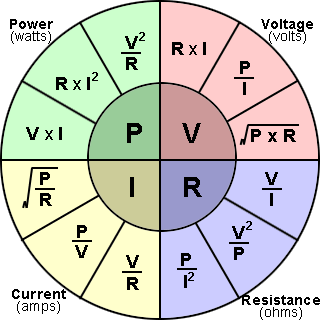
Current, voltage, and resistance are all related. When one of these changes in a circuit, it affects the others. The relationship between them is known as Ohm’s Law.
Voltage
Voltage is the difference in electrical potential between two points. It represents the potential to do work, and exists whether or not something is hooked up to a power source.
One way to think of voltage is to consider two water tanks suspended in the air. One is 30 feet high, the other is 10 feet high. The water in the higher tank has more gravitational potential energy. When we connect a pipe between them, water flows from the higher tank to the lower tank.
Similarly, with electricity, charges move from a higher electrical potential to a lower electrical potential. The difference between the two points is the voltage.
Voltage (V or E) is measured in volts (V).
Voltage (V) = Current (I) * Resistance (R)

1.5V = 0.001A * 1500Ω
Current
Current is the specific, measurable quantity of electrons flowing through a specific point at a specific time. Current is the rate of flow of electricity and is measured in amperes (amps). To get one amp of current, you need over 6 quintillion electrons flowing past a particular point per second. Current is similar to the amount of water flowing through a pipe. Higher amperage means more current is flowing.
Current (I) is measured in amperes/amps (A).
Current (I) = Voltage (V) / Resistance (R)

0.001A = 1.5V / 1500Ω
Resistance
Resistance is the opposition to current flow within a conductive material. Resistance can be thought of as similar to the width of a pipe.
Resistance (R) is measured in ohms (Ω).
Resistance (R) = Voltage (V) / Current (I)

1500Ω = 1.5V / 0.001A
Power
Power is the rate at which energy is transferred, used, or transformed over time. It tells you the instantaneous electrical power a device or system consumes or delivers at a given moment.
Power (P) is measured in watts (W).
Power (P) = Voltage (V) * Current (I)

0.0015W = 1.5V * 0.001A
Energy
Energy is the total amount of work done or power used over time. It is usually followed by a "h" for hour.
Energy is measured in watt-hours (Wh).
Energy (Wh) = Power (W) * Time (h)

3Wh = 1.5W * 2h
Electronics
Electronics is the study and application of devices that control the flow of electric current.
Every electronic system, from a flashlight to a smartphone, relies on understanding how electricity moves, how components interact, and how circuits are built to perform specific tasks.
Electrons move but not in any specific direction. Something needs to push them along a conductive path. What pushes electrons in a direction is an electric field. Electric fields can be created through chemical reactions (like in a battery).
A negative terminal (-) has a lot of electrons, while a positive terminal (+) has very little. When a power source with a positive and negative terminal is connected end-to-end with a conductive path, electrons flow from the negative side, through the conductive path, to the positive side. This is referred to as a circuit.
Electrical transducers change other types of energy into electrical energy and vice versa.