Circuits
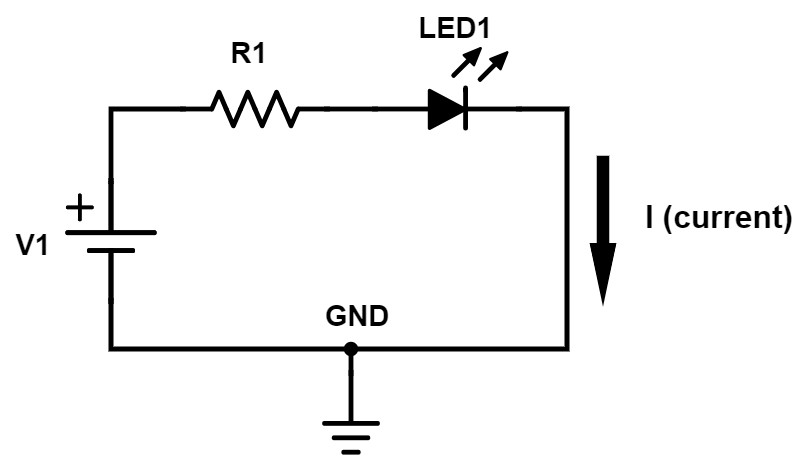
A circuit is a complete, closed loop or path through which electricity can flow.
A circuit is a circle. For current to flow, the path must be complete; a break creates an "open circuit," stopping the flow, while a complete path is known as a "closed circuit." Any break will stop the flow of electricity.
In a circuit, electricity flows from a point of higher potential energy to a point of lower potential energy. Ground (often represented as GND) is generally the point of least potential energy in a circuit.
Electricity in a circuit starts from a power source, moves through conductive wires, through circuit components, and then returns back to the power source.
A load is any component or part of a circuit that draws current and absorbs power from the source.
A short circuit happens when wires accidentally create a shorter circuit. Short circuits happen from their insulation layer rubbing off (for instance, mice chewing on wires).
Ohm's Law Recap
Ohm's Law is the relationship between voltage, current, and resistance in an electrical circuit.
When measuring amperage in a circuit, the values will most likely be in the milliamp (mA) range, which means thousandths of an amp.
Example: You have a 5V supply of voltage and a resistor offers 220 ohms of resistance. What is the current?

Voltage (V) = Current (I) * Resistance (R)
5 = Current * 220
Current = 5/220
Current = 0.023 amps, or 23 milliamps
Ground
The Earth is a giant sphere, approximately 7,900 miles in diameter made up of metal, rock, water, and organic material.
The Earth acts a large electrical conductor and an effective reservoir of charge. Because of its enormous size, it can supply or absorb electrons with negligible change to its overall electrical potential. For this reason, it's often treated as a reference point (ground or GND) in electrical systems.
Effective grounding requires a conductor with substantial contact with the Earth, such as a metal ground rod. The quality of a ground depends on factors like surface area and soil conductivity. Moist soil provides better grounding than dry sand because it conducts electricity more effectively.
Batteries
Something needs to precipitate the movement of electrons around a circuit. That’s where batteries come in.
Batteries generate electricity through a chemical reaction. The reactions between the chemicals inside a battery generate spare electrons on the negative side of the battery.
This chemical reaction can’t proceed unless there’s some way for those extra electrons can be pulled away from the negative terminal and delivered back to the positive terminal. There needs to be a connection of some sort. This is where wires come in.
The reactions in the battery proceed until all the chemicals are exhausted, at which time you properly dispose of the battery or recharge it.
- Flat end (-), negative terminal, anode
- Protruded end (+), positive terminal, cathode
| SR521 | 1.55V | ~14-18 mAh | Watches, small toys, calculators, low-drain electronics |
| SR41 | 1.55V | ~40-45 mAh | Watches, medical devices, calculators, small electronics |
| CR1025 | 3V | ~30-35 mAh | Miniature toys, small LED keychains, sensors |
| CR1632 | 3V | ~125-130 mAh | Mini remotes, small wearables |
| CR2032 | 3V | ~220 mAh | Watches, calculators, key fobs, fitness trackers |
| AAA | 1.5V | ~1000-1200 mAh | Remote controls, small flashlights, toys |
| AA | 1.5V | ~2000-3000 mAh | Remote controls, clocks, cameras, toys |
| C | 1.5V | ~6000-8000 mAh | Medium-sized flashlights, toys, radios |
| D | 1.5V | ~12000-18000 mAh | Large flashlights, boomboxes, camping equipment |
| 9V | 9V | ~500-600 mAh | Smoke detectors, microphones, handheld meters |
| Car Battery | 12V | ~45-100 Ah | Starting car engines, powering automotive electronics |
Wires
The longer the wire, the higher the resistance, and the less current flows for a given voltage.
The thicker the wire, the lower the resistance, and the more current can flow for a given voltage.
Different Types of Wires
Solid-Core (Single-Strand) Wires
A single, solid piece of metal (usually copper) inside insulation.
Stranded (Flexible) Wires
Many thin strands of wire twisted together inside insulation.
Jumper Wires
Pre-made wires used to quickly connect components, usually for prototyping. They are usually made of either solid-core or stranded wire, just packaged with connectors.
Wire Gauge
The thickness of wires is measured in American Wire Gauge (AWG). Wire gauge specifies the right diameter of wire for the appropriate amount of current.
The smaller the AWG number, the thicker diameter of wire and less resistance it has. The higher the AWG number, the smaller the diameter of wire and more resistance it has.
| Wire Gauge | Diameter (inches) | Resistance (ohms / 1000 ft) |
| 20-gauge | 0.032" | 10 Ω |
| 10-gauge | 0.1" | 1 Ω |
Circuit Basics
Components of a Circuit
Power Sources
A power source is something that provides energy. Common examples include a battery or a generator.
Conductors and Insulators
Electricity travels through conductive wires.
A conductor is a piece of metal that transmits electrical force over a distance. Common conductive elements include silver, gold, copper, steel, and sea water.
An insulator is something that blocks electrical force. Common insulators include rubber, glass, oil, diamond, and wood.
A wire is a conductor (usually copper) that is sheathed by an insulator (rubber).
Loads
A load is a device that uses the electricity. Common examples include light bulbs, an electric motor, or a resistor.
Switches
A switch is used to open or close the circuit.
Series and Parallel Circuits
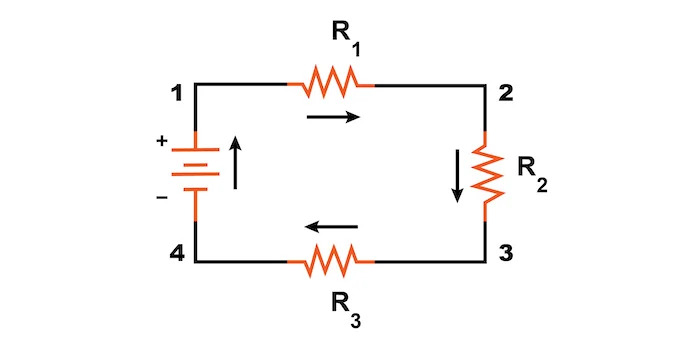
Series
Series circuits are circuits where the components come one right after another. Series circuits connect components in a "daisy chain" end-to-end on a single path, sharing current but splitting voltage.
The current stays the same throughout the circuit, while the voltage is divided among the components and dropped across each load. Total resistance increases and is always larger than any single resistor (one lane means harder for current to flow).
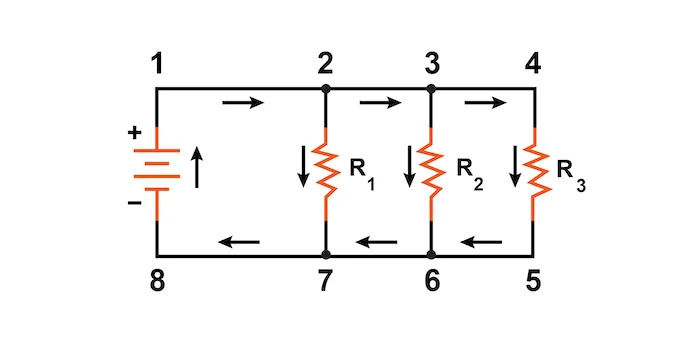
Parallel
Parallel circuits are circuits where components run side-by-side. Parallel circuits connect components on multiple branches, sharing voltages but splitting current between the components, and are more reliable as one break doesn't stop the whole circuit.
The voltage stays the same across all branches, while the total current increases as more branches are added. Total resistance decreases and is smaller than the smallest resistor (multiple lanes means easier for current to flow).
Passive & Active Components
Passive Components
Passive components manage energy without external power. Passive components simply consume, store, or release current.
- Resistors - Resistors limit or control the amount of electric flowing at a certain point. They don't amplify or generate energy; they simply oppose current.
- Capacitors - Capacitors store and release electrical energy. They can smooth voltages, filter signals, or temporarily store charge. They don't amplify signals, only manage energy in circuits.
- Inductors - Inductors store energy in a magnetic field. They are commonly used in filters, power supplies, and radio-frequency circuits.
Active Components
Active components require power to amplify or switch signals. Active components control current.
- Transistors - Transistors are semiconductor devices that can act as switches or amplifiers for electrical signals. They require an external power source and can dynamically control the flow of current. They are the fundamental building blocks of modern electronics.
- Diodes - Diodes allow current to flow in one direction only. Common uses include rectification (converting from AC to DC) and protection.
Circuit Components
Capacitors
Capacitors store and release electrical energy in a circuit. They can be thought of as a backup tank. When the circuit’s voltage is higher than what is stored in the capacitor, it allows current to flow in, giving the capacitor charge. When the circuit’s voltage is lower, the stored charge is released. Capacitors are commonly used to help smooth fluctuations in voltage.
Use a capacitor when you want to smooth voltage and reduce noise.
Inductors
Inductors are wires wound into a coil, like a spring. It stores energy not as electricity, but as an electric field.
Used in filters to clean signals.
Diodes
Diodes ensure electricity only flows in one direction. They are polarized, meaning that the direction that they’re placed in a circuit matters. Placed one way, they allow current to pass through. Placed the other way, they block it. The anode (+) connects to the side with higher energy, and the cathode (-), marked with a band, connects to the point of lower energy, or to ground.
Light Emitting Diodes (LEDs)
Light Emitting Diodes (LEDs) are a type of diode that illuminates when electricity passes through it. Like all diodes, electricity only flows in one direction through these components. The anode (+) is the longer leg and connects to power, and the cathode (-) is the shorter leg and connects to ground.
Resistors
Resistors add resistance to a circuit. They limit the amount of amps that flow through a circuit.
Resistors resist the flow of electrical energy in a circuit, changing the voltage and current as a result. Resistors convert some of their electrical energy into heat. Resistor values are measured in ohms, the colored stripes on their sides indicate their value.
Resistors are added because sometimes you just don't need that much pressure and volume for the application.
Potentiometers
A Potentiometer is a variable resistor that turns angle into resistance. You turn the knob for more or less resistance.
Transistors
Transistors are three-legged devices that can operate as an electronic switch.
They are useful for controlling high current/high voltage components. One pin connects to ground, another to the component being controlled, and the third to the control signal.
When the component receives voltage to the pin, it closes the circuit between ground and the other component.
In a bipolar junction transistor (BJT), one pin is the emitter, one is the collector, and the third is the base, which receives the control signal.
Switches
A switch interrupts the flow of electricity, breaking the circuit when open. When a switch is closed, it completes the circuit. There are many types of switches.
A fuse is a protective device that breaks the circuit if the current exceeds a safe level. It can be thought of as a sacrificial or self-destructive switch that protects the wires and loads from too much current draw.
A circuit breaker is a type of fuse that can be reset.
Drawing Circuits
A schematic diagram is a simplified representation of an electrical circuit that uses standardized symbols to show components and connections.
Schematics use symbols to capture the essence of circuits. They present the components and the ways they're connected in a clear, succinct, and unambiguous form.
Building Circuits
Solder is fusible metal alloy, typically made of tin, combined with copper, silver, or lead, used to create permanent, conductive electrical or mechanical bonds between metal parts.
Solderless allow for electrical connections without melting solder, providing fast, reliable, and reusable alternatives for prototyping and repairs.
Breadboards
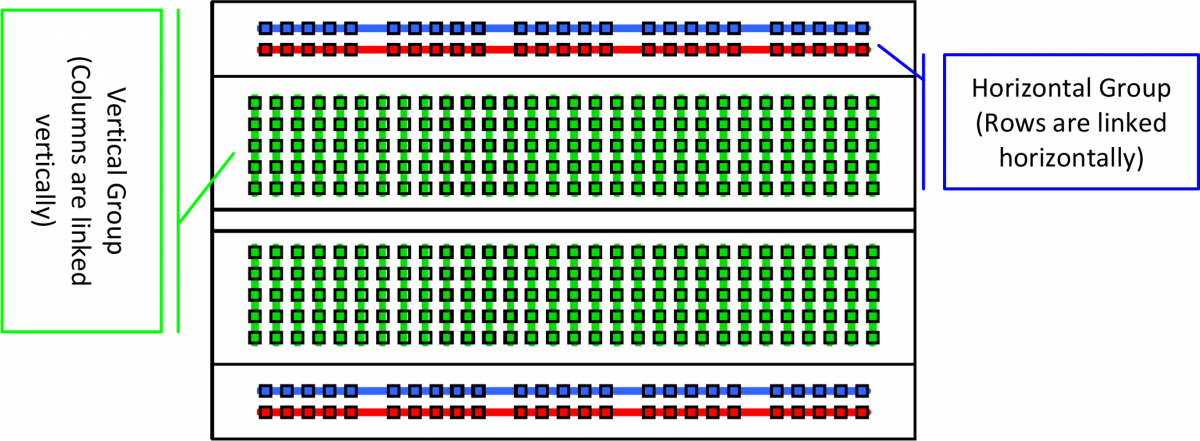
A breadboard is a reusable platform for prototyping and testing electronic circuits without soldering. They allow for quick changes and experimentation.
The horizontal and vertical rows of the breadboard carry electricity through thin metal connectors underneath the plastic with holes.
- The 5 holes in each horizontal row are connected electrically through through metal strips inside the breadboard.
- The vertical strips that run the length of the breadboard are electrically connected. These are called the Power Bus rails. The strips are usually used for power and ground connections.
- The middle row breaks the connection between the two sides of the board.
Loose Wires
Breadboards are typically used with solid-core loose wires, which allow for easy experimentation.
Flexible stranded wires are used for permanent or moving connections.
Jumper wires come with male and female ends for connecting between breadboards, sensors, and modules like an Arduino.
Printed Circuit Boards (PCBs)
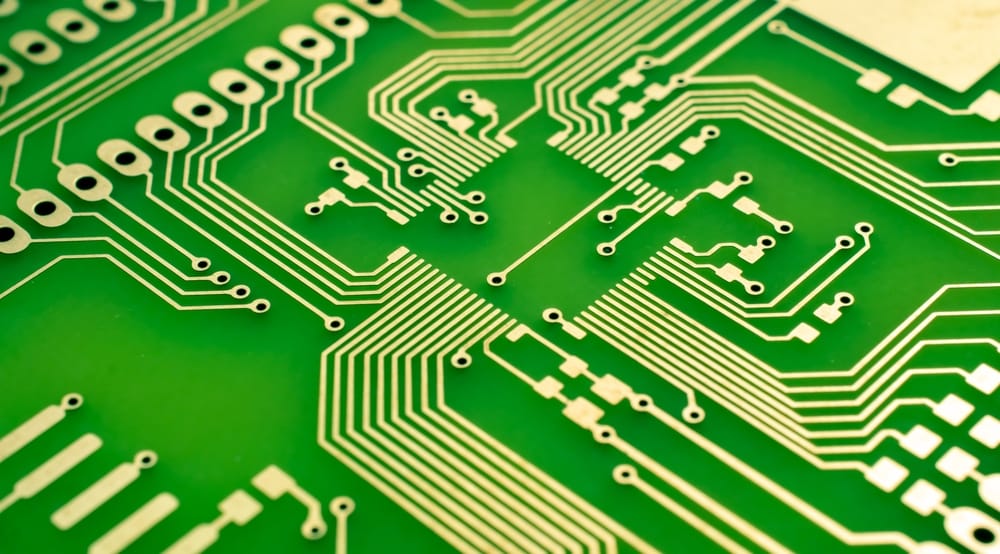
Printed circuit boards are physical boards that provide mechanical support and electrical connections for components. PCBs contain layers of insulating material with copper traces that form the wiring of the circuit. They are essentially the "skeleton + nervous system" of an electronic device. PCBs may include multiple layers (single, double, or multi-layer).
Traces
Traces are thin lines of a conductive material (usually copper) that connect components on a PCB electrically, replacing loose wires.